Wednesday, August 31, 2011

Summer Treats


Santa Rosa plums.

I have been canning different kinds of fruits from our backyard lately. Plums were made into  plum sauce which we like to put on pancakes.  The grapes (Pinot Noir) that were planted by the patio for shade also give enough fruits to make into jelly.  I can' remember the last time we bought jelly from the store - it has been a long time. 


'Bartlett' Pears were made into pear butter.

Our Bartlett pear was full of fruits this year.  Miriam and I are the only ones eating the fresh fruits.  The rest of the family complains about the texture of the fruit. I discovered later on that they all like pear butter - especially when used as topping for Buttermilk waffles.  Shannon and Miriam also like to eat it alone for dessert or snack.  I know for sure that pear butter is nutritious.  So far I have made two batches of this 'pear delight' but this is probably not the end because there are still a lot of fruits on the tree. 

The kids harvesting grapes.


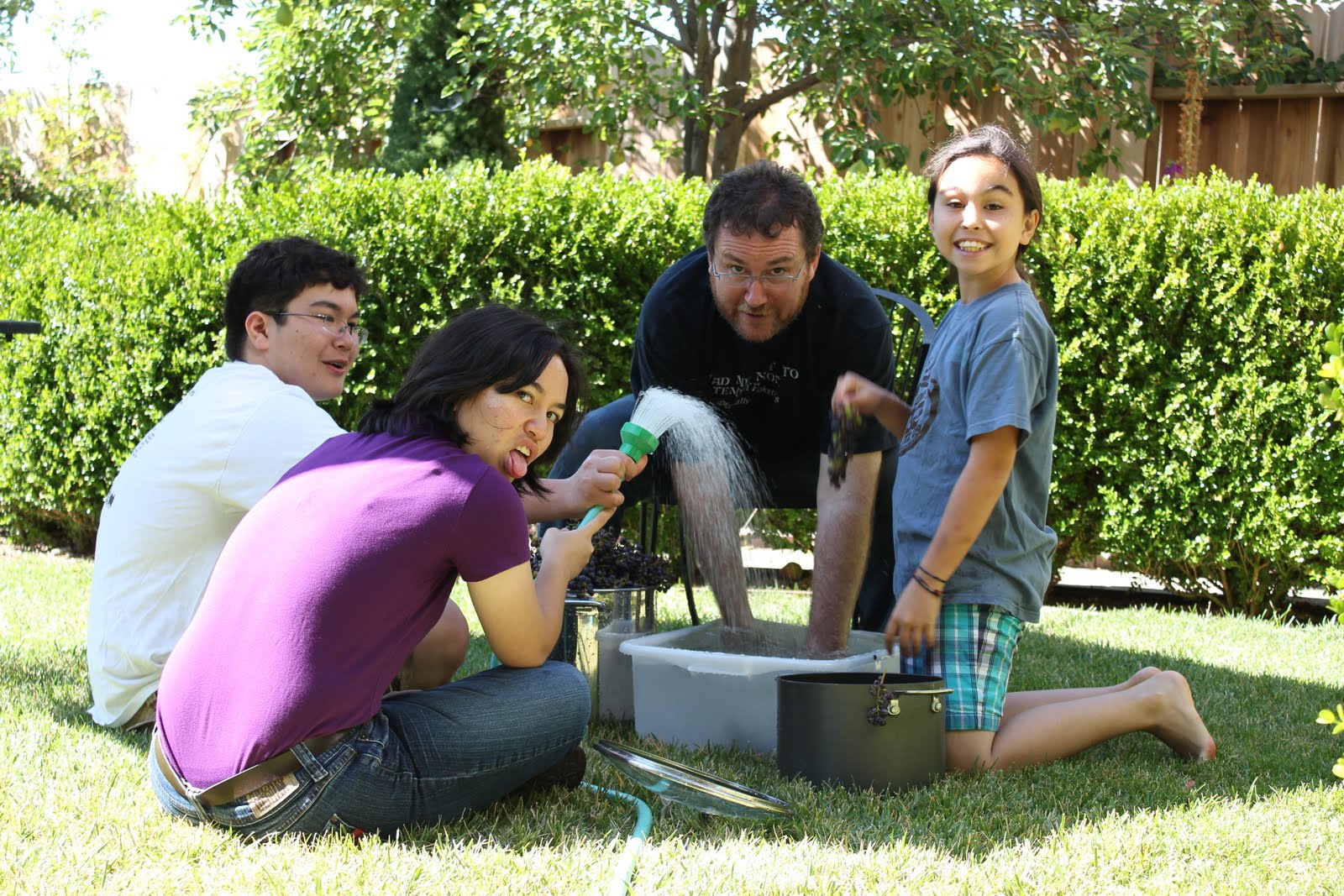
Grapes are cleaned and washed before they are crushed.

At the Farmers' Market, our friends (Gavy and Bellie Dhillon) gave me a special deal on apricots hence I bought half a box (approximately twenty five pounds).  I made a pie and then the rest were made into delicious jam.  Tim always appreciates good apricot jam or preserves, and now he has enough supply for a year.  In fact we have enough to share.  We like our jam to be on the tangy side of the spectrum - and this is exactly how these apricots are made.  I can just imagine crepes and apricot preserves in our future.

Thank goodness our peaches did not do well this year...we have enough canned fruits already.

Washing grapes - a family activity.

Tuesday, August 23, 2011

Alone Now

Auntie Alie  (Santa Ana - 2010)
Today is a sad day.  My aunt Arcelie (Alie) lost her dearest husband; and my cousins Joan, Arnel, Maylene and Wilson lost their father. Uncle Roman passed away after a long time of suffering from cancer.  The last time I saw him was when my family went to the Philippines last November.

Uncle Roman and Auntie Alie were teenagers when they got married.  They used to bring me with them when they visited his family in Makirit.  There I I enjoyed playing with one of Uncle Roman's nieces - Linda.  All of his siblings were engaged in commercial squash growing.  It was very fascinating to see tons of squash harvested and piled up on their yards. 

My uncle and aunt on the other hand, decided to focus on rice farming.  They started their family in Santa Filomena.  There they bought a house that was made of all wood.  I was a little girl when they moved the house through bayanihan.  Bayanihan is a process when all the men in the community gather together to move a house - literally.  In its original original location, the house was surrounded with coconut trees.  Several trees had to be chopped down to make way for the house.  I also got to watch a water well dug and built in their backyard.  I had so many fond memories at their house as a kid.

Uncle Roman (2008)


They used to own a big hectarage of rice fields.  They also owned a lot of land, carabaos and horses.  I still remember their kalesa which was painted with a greenish color.  The picture registers in my head in an impressionist style now - I can't see the details anymore.  I think uncle Ninoy Pacis painted it for them since he was the only painter/artist in town. 

Then later when uncle got a job at the saw mill in Lallo the family moved.  He stopped farming and they sold all their carabaos and horses.  Years later, they also sold their house in Santa Filomena which signified their intention to live in Lallo permanently.  At this point, my cousins who used to live a few yards away are now several bus rides away.  The good thing is that they lived near the Cagayan River - they would always bring some ginukan along when they came to visit us.  My aunt loved my mother (her sisiter) that she visited her often.


Almost-complete Galvan Family (2008)

Many years later, I left the Philippines and did not see all the things that happened since then.  However, every time I went back to the Philippines, Uncle Roman and Auntie Alie always made sure to bring my cousins to come see me.  Eventually, it was not only my cousins that they brought but also my cousins' children.  I have a picture of Shannon as a baby with Maylene.  Last year when Tim and I brought our kids to Cagayan, Uncle Roman was already very sick to come and see us at our house in Abulug.  Instead we went to see him in their house in Catayauan, Lallo.  I was very sad to see him so thin.

Now he is gone.  My aunt will be all alone.  The good thing is that her house is surrounded by her children that they share the same yard.  This proximity with her children and grandchildren will, hopefully, ease the transition.

Friday, August 5, 2011

Colombia Part 2: Bogota

The Cathedral at the Plaza de Bolivar

After Medellin, we went to Bogota and did a little bit of sightseeing.  We were so spoiled in Medellin - the Actises were always there making sure that we were safe.   However, Bogota provided us the freedom to go around even to the point of getting lost in the city and making our way back by asking, using the little Spanish that we know.  We took taxis where ever we went.  Most of the time, we would not understand how much we were supposed to pay.  Fortunately, Shannon was there to translate for us. 


Posing on the misty Mount Monserrate.

When we arrived in Bogota, I had the impression that the city looks desolate and frightening.  Buildings that line the streets were closed.  They have the rolled-down doors which made the place appear unfriendly.  Tim and I walked around the hotel which is located in the heart of business area signs of life were missing. The sidewalks were without people.  We could take a taxi but places that we wanted to go see were closed including the Museo Nacional de Colombia (which we visited later in the week).  Well, to explain this phenomenon, we arrived there on a Sunday.  Firstly, Colombia being a Catholic country closes on Sundays as a general rule.  Secondly, Monday (June 27) was a holiday - I think it was Corpus Christi.  Everything was still closed but we got to go eat at one of the two restaurants that were open near the hotel.  We opted to try the Italian Restaurant instead of the Barbeque place.  We must have been the only customers that night.  Tuesday came and the city suddenly looked inhabited as if the people got up from a slumber and began to mill around the city once more.  Suddenly the city exuded with life.  Bogota is alive after all.  Next time that we head to a new city, I would do my research and check the city calendar ahead of time.  This reminds me of a different experience we had as a family.  A few years ago, while traveling in Britain, we decided to take a quick train ride to Wales from Hereford.  As soon as we got into the train, we knew something we didn't know was going on.  There was a huge rugby game at the Millennium Stadium.  It was quite an interesting experience.  We were lucky that none of us was wearing the color of either team (use your imagination). Had we known, we would have chosen a different destination that day. 


View od Bogota from the tramway.


Candellaria - Central District of Bogota.

At the time we were in Colombia, Bogota was under renovation.  Most of the major streets were partly closed due to the construction of the new Bogota Metro.   The people we talked to Bogota were apologetic of the current dust and construction mess all over the city.  The condition did not bother us at all nor did it hinder our tour of the city and our search of unusual Colombian souvenir (i.e. Greca coffee maker).

Casa Santa Clara Restaurant


Station of the Cross at the Montserrate

 As a Spanish colony in its early days, Colombia is a Catholic country.  In Bogota, we visited an old church located on the top of Mount Montserrate (named after the Montserrat Mountain in Spain).  The mountain is so high that when you are up there, you get a panoramic view of the city.  There are two ways to go to the top of this pilgrimage/tourist destination:  Aerial tramway (cable car); or Funicular.  Going up, we opted to take the latter and came down by cable car.  

Bogota rests on an altitude of about 10,300 ft.   In spite of the fact that it rests along the equator, its temperature remains pleasantly cool or cold throughout the year.  The fluctuation in the temperature and daylength in Colombia is negligible.  This is the reason why Colombia is the place to grow flowers.  Eighty percent of the cut flowers sold in the US are grown in Colombia near Bogota.  Flower growers do not have to work around the changing seasons.  If weather conditions were the only consideration for choosing a place to live, Bogota would be on the top of my list of choice cities.  Unfortunately, there are more things to be accounted for before weather conditions.

Tramway


Colombian food is mild.  We expected something like Mexican or Belizean food, but we were wrong.  On the plane I got the chance to sit with a Colombian girl who was going home to visit her folks in Bogota.  She told me to make sure that I'd try Ajiaco, a Bogotano signature dish. Basically, Ajiaco is a soup that is made of five varieties of potatoes. Each variety is supposed to add something different to the taste or texture of the soup.  Chicken cubes are added to the soup and it is served with corn on cobb, cream, capers, salsa, avocado, and rice.   I had Ajiaco Santa Fereno at the Embassy Suites and it was great.   I can understand how it earned its status as a Colombian comfort food.  On a side note, however, Californians might fail to appreciate the soup because they are no potato connoisseurs. 

Feeding the doves can be very entertaining.


Juan Valdez - the Colombian counterpart of Starbucks.


My experience in Colombia defied all my expectations.   I knew that the country is in the tropics  where coffee (Coffea spp.), coca plants (Erythroxylum coca), roses, and other flowers.  And that's about it; everything else came as a pleasant surprise for me. 

Souvenir picture taken from Mount Montserrate.

Next time, I'll write about my observations and interactions with the people of Colombia. 

Monday, August 1, 2011

Miriam's Eleventh Birthday

Miriam on her eleventh birthday.

This is the girl I call my surprise baby - smart, beautiful and in some ways exotic.   She's growing up and trying to catch up with her siblings whom she loves so much.   It is hard to believe that the baby I gave birth to shortly after we moved to El Dorado Hills is now in middle school. 

Mriam and Will Leszinske

On her eleventh birthday she chose to invite some friends to come over.  First we had pizza, went to the Ridgeview Park to play "Capture the Flag", and then played with water balloons.  When they got tired and after the faucet was broken, we came back to the house to have some apple pie and to open presents.   After all the basic birthday activities, they did other things such as look at Will's YouTube channel,  laughed at them a lot, jump up-and-down on the beds in Miriam's room and breaking one of them. 

Miriam, Becky and Will


Miriam and Erich Lippuner


Miriam with Janae Bonnel, Emily Kennedy, Becky Carmichael, Erich Lippuner, and Will Leszinske


Her new cajon (a percussion instrument) - a birthday present.

One of her current interests is band.  She loves being in band and enjoys learning to play all sorts of percussion instruments at school.  One of the presents we got her is an instrument called  cajon.  Basically it is a box which combines bass and a snare drum. She can sit on it while she plays it.  Recently she has been asked to train to replace the drummer (who will soon graduate) for Youth Band.  Also she continues to take drum lessons under Cameron Carbrey.

Saturday, July 16, 2011

VBS 2011

"Train a child in the way it should go and when he is old he will not depart from it." ~ Proverbs

Vacation Bible School is a church tradition that my family get involved in.  Every year our church opens her doors to small children - teaching them about God and his love.

We just completed this year's VBS.  All of us were involved except Tim who is currently on a back-to-back business trip (Raleigh, North Carolina, and San Diego, California.  Shannon and Brahms played in the VBS band while Miriam is worked as a crew leader.  I, on the other hand, am taught 3-4 year-olds and was a crew leader to some them.  

In terms of weather, I could not imagine any better week than this week to hold a VBS.  High temperatures are in the 70s and 80s.  Children and adults are mellower when the surrounding temperature is pleasant.  Smiles, kindness, and silliness prevail over stress, and complaining.  Reason and purpose have a greater chance of remaining intact when everything else is favorable. This is an important consideration especially when dealing with the vulnerable species of mankind, whose brain-wirings are currently in the process of completion, called children.  After all, VBS is all about  positive stimulation of the young brain to give the spiritual side of their minds a chance to be exposed to the right early experiences.  The book of Proverbs simply says, "Train a child the way it should go and he will not depart from it."

I like teaching and caring for little children.  Children are beautiful people.  They are charming and full of surprises coupled with energy.  Their innocence and dependence coupled with their honesty grant them the license to be so adorable.  VBS gives us the chance to connect with kids which we wouldn't normally have the opportunity to connect with.  However, I regret that the structured nature of the VBS leaves very little time to make real personal connections with them.  Every minute is dedicated to something that needs to be done.   With this age group, half of that time was spent in herding them to the right corral.  One might say that "They have to hear this and that."  but the thing is - these kids have very short attention span.  On the third day for example, snack time was not just distributing the food; leaders were also asked to paint every kid's arm with the wordless gospel symbols while carrying the bottle of ketchup around and running to fetch water at the same time.  It would have been more meaningful if the crew leaders sat down with their kids and had one on one conversation no matter how short it might have been.  But then again, that's just a thought.

Overall, the VBS went well.  It was fun getting to know the different kids and learn about their idiosyncrasies.  Some of them reminded me of my own children when they were small.  I got to work with and know Linda (from Lake Hills Church), Alyssa Moser, James Wu, Joel Henry, Ethan Keen, and most of all my own daughter - Miriam.  All of these crew leaders worked hard to make sure that the kids were safe and in the right place.

Julie Gillham, did a great job organizing the whole project.

Thursday, July 7, 2011

Colombia Part 1: Medellin, Antioquia

Medellin at night.  (Photo by Matt Actis)

A week ago, we came back from our trip to Colombia.  My experience defied my pre-conceived idea about the country and its people.  Our purpose in going there were was two-fold:  to make ourselves available to help the Christian workers in that area (mission trip), and to see and enjoy Colombia and what it has to  offer (fun trip).   It was a great trip.  And I will try to preserve details of our experiences by writing them down. 


The City
We spent ten days in Medellin as our central station.  From there we travelled to different towns around.  Medellin is like a huge bowl - a city that is on the mountains and surrounded by even higher mountains.  I believe that it is a caldera - created a long time ago through the collapse of the ground due to a major tectonic activity.  In the valley there are hills which probably were formed through later volcanic eruptions.  There is a limited flat area in the city. The houses and buildings are built on the slopes.  Moving around the city means either climbing up or going down stairs.

Poorer communities are situated on the higher part of the mountains.


The pictures don't show but Medellin looks like a Lego-land that is made of bricks.  Bricks are the most noticeable building material throughout the city. The mountains are predominantly clay - thus brick is the most practical material for building walls.  At night when the city is lit, it looks like a huge bowl that is over-flowing with twinkling gems.  In short, it is beautiful.  I imagine that in every building, you get a view of the city.


At an elevation of 4905 ft (1495 m), Medellin has a very pleasant temperature - and because it is located on the equator, the temperature remains relatively constant throughout the year.  During our time in Medellin, it rained every night and was sunny with some clouds during the day.   The funny thing was that the people, complained, "Hace calor", meaning "It's very hot", whenever they are exposed to the sun.  Then when they are in the shade, they'd be saying "Muy frio." (It's v ery cold.)  I guess people's reaction to climate is all relative.  For me, Medellin was very pleasant through and through.

People and their Food
Medellin is a city in the state of Antioquia. The people born in this state call themselves "Paisa" and they are proud to be so. There is a food combination which they call as "Bandeja Paisa". This is composed of eleven different ingredients: ground meat, blood sausage, beans, rice, fried plantain, arepa, chorizo, egg, avocado, chicharones, and something else.  Every Paisa is proud to serve this to their most honored guests. If you happen to be one of their guests, you can be gracious by sampling all of the components of the huge platter of food.  The individual components of the bandeja are applied in different dishes.  For example - arepa was served every day during the ten days that we spent in the area. 

One of the best ways to learn about a culture is to visit a local market or at least a grocery store.  In Medellin, we got to wander in a huge open market called Minorista;  it is full of different fruits and vegetables - most of them are only found in Colombia.  I was surprised to see that there is a big section dedicated to meats as opposed to a tiny fish section.  Corn and potatoes are the other single commodities that took up a huge area in the market place.


I enjoyed eating fresh fruits everyday and drinking freshly squeezed juice.  Sometimes the juices are mixed with milk to tame the acidity that comes from the fruits.  On the other hand, some fruits are served with a drizzle of lime juice and a sprinkling of salt to achieve the same effect on fruits.

Arroz con Coco, Patacon and Fried fish

Avocados, mangoes, pineapple,  maracuja (a species of passion fruit), blackberries, lulo (Spanish common name -naranjilla) and guanabana (soursop) are all very common.   Except for avocado, they can all be made into delicious drinks either "con leche" or "con agua".  There are a lot more fruits that I could not identify found in the market place.

Potato, along with yucca (cassava) and corn, is a huge part of their diet.  Every Colombian I talked to seem to pay homage to the potato.  I was surprised to hear Maria (who cooked for us during our stay in Medellin) talk about the differences between three types of potatoes in Colombia.  I've learned from my research that the three most popular potatoes in Colombia are Papas Criollas (Solanum phureja 'Criollas'), Sabanera (Solanum tuberosum 'Sabanera') and Pastusa (Solanum tuberosum 'Pastusa') The Criollas are small yellow potatoes which are very creamy; they are used in a lot of their dishes but I like eating them roasted or boiled with a little bit of butter.

People and their Customs
Colombians are very friendly and hospitable people.  They serve aguapanela (a drink made with dissolved blocks of molasses with a lime juice), tea, and tinto (black coffee) to show their hospitality and affection.  They are also fun to be with.  For example, Magdalena and Oscar came to dance for us.  Then they encouraged us to dance with them as well.  We tried... Everything would have been perfect for establishing good relationships with the Colombian people.  However, they speak only one language - Spanish.  This is a problem because I do not speak Spanish.  I realize that friendship requires a common or shared language.  It's difficult to be friendly when we cannot express our thoughts nor understand the thoughts of the other person.  Thanks to people we met like Miriam and Jim Marquardt and Manuel Ramos who interpreted for us when my daughter Shannon was not around.  When I listened carefully, I could get a general idea of what they were saying.  The Filipino language and dialects contain many Spanish words and I recognize them.  However, I know nothing about Spanish grammar.  I cannot conjugate verbs, thus speaking it was not an option.
I tried hand motions and exaggerated facial expressions - surprisingly enough, sometimes they worked.


It was a Thursday night when we arrived in Medellin.  The following Sunday was a big night because Medellin's "Nacional" played against Bogota's "La Equidad" soccer team.  These two cities have an on-going competition; each citizen claim that their city is the better one. The Nacional won and you can guess what happened that night.  The whole city was in a mode of jubilation.  Screaming, honking, shooting of guns into the air, waving of flags and banners at every passing vehicle, fireworks, and drinking were everywhere.  It was a very happy night for the whole of Medellin but it kept me awake until I decided to use ear plugs.  Later that week we went shopping in Hunin.  I was bargaining on the price of a Colombian flag when the vendor decided to give it to me at a very low price because his team Nacional won the previous game. 

Colombians do not go out in flip-flops.  They are always in shoes or at least sandals.  I am glad that we were pre-warned about this custom.  When it comes to bathroom- manners, Colombia and Belize share something in common.  Toilet paper does not go into the toilet; it goes into the trash can. I know it is hard to imagine but it is  true.  Along the streets or near parks you'd see vendors selling sliced fresh fruits arranged in plastic cups and you can eat them with palitos (toothpicks).

The Seminary
In Medellin, we stayed at the apartments which are owned by the Biblico Seminario, the only bible seminary in the city.  Our friends Matt and Shelley Actis and their family live there while they prepare themselves for their ministry in Armenia, Colombia.  

The seminary campus is located on a hill, of course, on one side of the street.  This is the side where we met with our hosts on a daily basis and ate our meals.  On the other side of the street are the apartments where we stayed.  We did not have to climb hills but we had to climb up to the third floor many times a day.  Having lived and walked in El Dorado Hills for eleven years, I would have been prepared for this terrain.  However, the altitude provided an unexpected challenge for my lungs. 

Both sides of the campus are gated.  So every time we entered or went out, someone would open the door for us - manually on one side and mechanically on the apartment-side.  That means that during the course of the day the gates were opened for us at least eight times.   The good thing is that we felt protected.

Monday, June 13, 2011

Two days before Colombia


We are finally getting ready for our family mission trip to Colombia.  Last night I stayed up late to work on a lecture that I will be delivering to a group of farmers.  That's right. I will have a chance to use my knowledge and experince in horticulture although I must say that I am a student when it comes to the climate and the traditions of the farmers there. 


So far, I have packed two 50 lb suitcases full of ministry and gift materials.  Miriam and Brahms are almost packed.   Tomorrow I will be packing my clothes and finalizing my "hort talk".   Tim checked with American Airlines policy on baggage - and yes - we are allowed two free checked-in suitcases.  

Tomorrow will involve more packing and re-checking the tiny details that we have to pay attention to - such as my thyroid medicine, Shannon's extra contact lenses, passports, etc.  Thank goodness my children are all well-travelled that I don't need to do anything except to remind them or in the case of Miriam - I check her suitcase after she's done packing.  Although Tim is that onew ho travels the most in this family, most of the time I am the one who prepares his clothing.  When we travel together, though,  he gets to do it himself. :) 

We have stopped buying more food as we try to finish what we have in the fridge - and really it is amazing to see how clean the fridge is looking these days.  We have been eating mostly from what we have in the freezer and the pantry instead of fresh foods.  Tonight we made pizza and it was yummy.  For tomorrow I am thinking of making pancakes, eggs, bacon and canned pineapples - again.