Showing posts with label Art. Show all posts

Tuesday, October 31, 2017

Never a Still Life


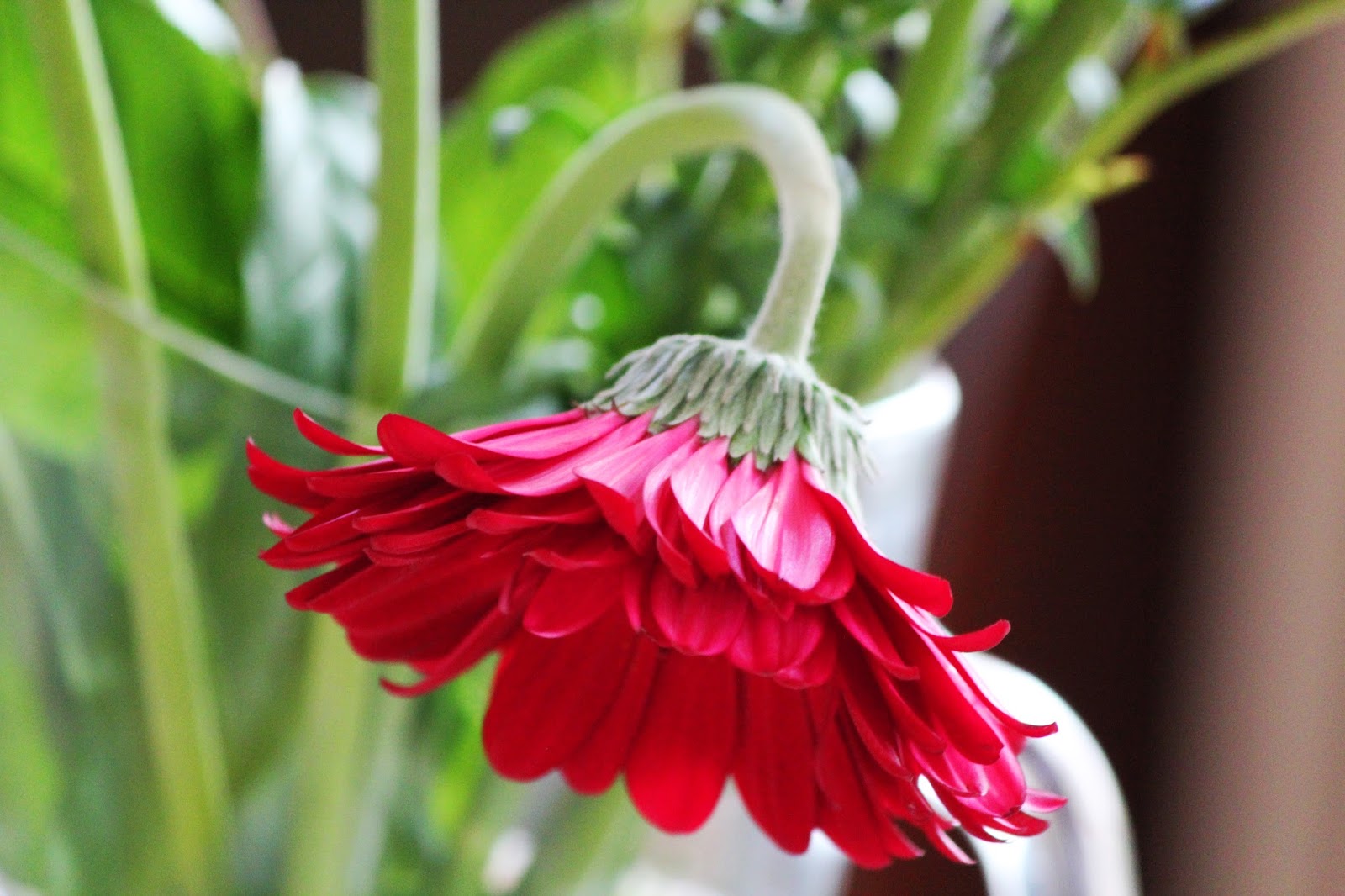
Painting flowers can be frustrating sometimes.  One night I started a project on very fresh flowers and the next day they were all facing downward. We often hear the phrase 'still life' to refer to certain works of art.  Still life, according to my uneducated interpretation, has one characteristic - staged and unchanging.  The image is maintained.   

Still life is meant to be still.  However, in the case of making art using things that are organic (living matter) there is no such thing as still life.  My art is currently focused on botanical subjects, in other words- perishables.  Assuming that lighting is a controlled factor, my reference fruits and flowers are never still. They change, the flowers droop and loose petals, the fruits get spots and they shrivel a little more everyday, the leaves dry out and curl, seedpods crack open and burst, etc.  Not that these are all negative occurrences - no in fact they display very interesting, uncommon and sometimes even more beautiful form. All these observations happen on my drawing/painting table on a daily basis.  Therefore, it is fair to say then that there is no such thing as still lifeStill life is an anachronism.  Life can't be still.  Only lifeless things can be still.   This is not a new revelation or discovery because it has always been that way.   Rather it is a matter subversion.  :)

Well then, let me take this opportunity to digress.  Life is never still.  Life is timed.  Time dictates the movement of life and man cannot do anything about that.  King Solomon in his God-given wisdom understood this dance between life and time when he wrote the third chapter of Ecclesiastes.


There is a time for everything,
and a season for every activity under the heavens:
a time to be born and a time to die,
a time to plant and a time to uproot,
a time to kill and a time to heal,
a time to tear down and a time to build,
a time to weep and a time to laugh,
a time to mourn and a time to dance,
a time to scatter stones and a time to gather them,
a time to embrace and a time to refrain from embracing,
a time to search and a time to give up,
a time to keep and a time to throw away, 
a time to tear and a time to mend,
a time to be silent and a time to speak,
a time to love and a time to hate,
a time for war and a time for peace.  
~~ Ecclesiastes 3:1-8

"He has made everything beautiful in its time." (v. 11)  But we, in our natural mind, desire to preserve specific moments of this life.  When we're having fun, when we're experiencing glory, when we have a lot of money, when the people around us are accepting, when we're healthy, when they are healthy, when we're skinny or when our skin is tight and elastic :) we want to freeze it.  We strive to keep it that way - like a still life where the only change is the accumulation of dust.  But alas, we do not control life.  Life is timed.  There is a time for everything and therefore laughter cannot take the time allotted for weeping.  God obviously designed life so that we get the total package of experience.  It is a test we all have to take.  What then can we do?  "There is nothing better for a man than to enjoy his work, because that is his lot..." (v. 22)  We are left to deal with our attitude towards everything under the sun.   

Going back to art now, 'still life' can still be achieved by faking the effect of time on a perishable subject.  A quick snap shot preserves the image.  In life, we can file those memories that we like to keep. And even though we cannot linger on one enjoyable segment, the memory of it might remind us that time keeps a tight schedule and that the next segment might be different but equally beautiful.


Life is never still.  Life is timed.   

Wednesday, July 19, 2017

Learning is a Journey Not a Destination


In this life there comes a time when we reach a certain level of expertise in one area which then creates a confidence that flows in all areas of life.  This is usually good and often considered emotionally healthy.  This has been my observation on my own and other people around me.  But sometimes the confidence we derive from excelling at one thing goes beyond some boundaries and it becomes a license to feel superior at everything.  This is not a good thing.  It makes someone emotionally, unhealthy.  It hinders learning.

Beat your last record.  With my recent attempts to engage in a new form of art, in spite of my 59 years of life experience and a PhD,  I have to position myself as a student/beginner putting all other measurements of my own abilities in other areas of life.  As a student, in this new area of interest, one of the first things I've learned is that if I want to excel then I have to tread the long road towards excellence.  I am at the starting point of this road and if I want to get better then I have to look at this road as one without end but with every step taken a new terminal towards my goal. The question would then be:  Is this terminal moving me forward or is this taking me in a loop?  There are no short cuts to getting better but to walk the road.  To keep on is the only way to get ahead and the only measure of improvement  is based only on my improvement from my own starting point. This idea positions me in the right place. If my painting is better than the last one I made then I am moving forward. Sometimes, subconsciously, I compare my abilities with others - which I think is a stumbling block in my improvement as an artist.

Strive to Improve.  It is good to appreciate other's works and skills especially if they are taken as inspiration to get better.  I'm my case, I follow a number of artists on Instagram to learn from. As they say, every expert was once a beginner.  No one skips that.  However, there are times when I lack the motivation to push forward because my improvement seems nil and unmeasurable.  But as in any advancement, the change is not guaranteed a constant speed.  Learning does not happen at a constant speed.  And yet this is all part of a balanced life I'm talking about.  One must strive at some areas while being proficient in other areas.  We learn from others while others learn from us.  No one monopolizes one side of the equation.  We all have a fair share of both ends.  This is how social balance is maintained. This is what makes the journey more fun.  Even my former elementary school classmate who is now a surgeon in Chicago admits to striving to learn about new advances/technology in medicine just to keep his practice current.  For what kind of world would this be if everyone is exactly as good as each other in all subjects? Nothing less than boring, I would say.

Look Up and Learn.  Sometimes when we start on a journey, there is an anxious longing to get to the destination that we miss to appreciate journey.  There is the dream that when we get to the top, that we will be great.  However, time and time again we see that the end is often  a let down.  The end brings us closer not to the imagined glory but to another level of a challenge.  I find it both stimulating and humbling to be at the bottom of the learning process (in art).  I can learn something new from those who have traveled the road longer than than I did.  And sometimes I hear them say something very simple but I keep that in my head and apply it in my next project.  On the other hand being on the bottom of the ladder also helps me appreciate the struggles of those who may yet have to learn what I have already mastered.  Learning is not a destination, it is a journey. 


"Painting is damned difficult - you always think you've got it, but you haven't."   Paul Cezanne

Sunday, April 30, 2017

Familiarity is not Mastery


Pink Cymbidium: A Study

Cymbidiums are in bloom in my backyard right now.   They bloom every year - the earlier ones blooming in January and the late varieties are just starting to open now.  When they are in bloom I move them to the patio close to the kitchen window and door so that we can enjoy them throughout their showtime.  In addition to that, I also cut and bring in some of the flowers.  As a matter of fact, a vase sits at arms length from me as I type.  I'm saying this to make a point that I spend a lot of time being close to these flowers.  However when I tried to paint one of them, I found it so much more difficult to portray the features of this remarkable flower than I had imagined.  It bothers me that my paintbrush does not confirm what I think I know.

Because we are familiar with something does not mean we have the mastery to depict or characterize it with accuracy.  It takes a careful study and understanding of a certain subject for an accurate retelling of the way something actually is.  In my pursuit of art, my style tends to lean towards realism which makes it even more frustrating especially in this early stage of my learning. The more I pay attention to my reference the more authentic my painting looks.  The closer my painting looks like my reference, the happier I am and vice versa.  We all like good art like we all like good stories.  After all, art is a form of story-telling using a different language.

 I will digress and bring this truth into my social life.  My relatives, friends and acquaintances from my different social circles are all familiar to me.  I interact with them in varying depths and so I claim with all audacity to know them.  However, in the same way that I cannot easily paint the picture of cymbidium, in spite of basically living with them, I do not have the license to assume I can accurately retell someone's story without first investing effort and time in understanding them.  The older I get the more I believe in the saying - "Little knowledge is a dangerous thing."  Stories made out of meager bits of facts can lead to deception and false representation.

Attentive listening for the sake of understanding - not for the sake of concocting prescription - is like staring at a flower for the sake of accurate portrayal.  There is a true story that lies behind every assumption.  But why is it that as social beings we are content in knowing just one side of the story of people around us?

Familiarity maybe incidental, but mastery is intentional.

Friday, October 28, 2016

Art: Retelling and Recreating (Part 2)


If art is retelling or recreating an experience for others to see which in turn results in our own sense of joy, then living is art in itself.

We live the way we do because we had experienced something.  We eat because we know it makes us feel satisfied.  So we feed our children or our pets.  When we give food to the poor because we know how it feels to be hungry and would not desire hunger on anyone else.

Art is sharing an experience.
One of the things that inspired me to draw was seeing an illustration of a plant in one of my gardening magazines.  I tried to copy it with my own hand and pencil; with careful observation and a a lot of erasing and redoing I was able to replicate the picture to some extent.  And after comparing my work with the original picture I felt a sense accomplishment.  Everyone lives the way we live because of our experience.  We experience something and because we think it is beautiful we recreate it.  Of course we all have our own criteria of beauty.

A long time ago, the bible tells us, God sent his son Jesus Christ to the world in the form of flesh and blood so that the world can experience Him.  Jesus Christ, in spite of his deity, came as a regular man to show mankind what a beautiful life looked like. God wants man to experience that life that delights Him so that we might be able to copy it.  It was not easy but He did it because he loved of the world.  The life he lived was so radical that some didn't see the beauty in it.  However, some saw it very clearly.  So starting with his disciples, people begun to mimic and retell the truth that they experienced. The apostle Paul, for example, was so  convinced that he had a sharp grasp of that life - he writes in a letter to the Corinthian church (1 Cor. 4:16), "Therefore imitate me."  He had a first hand encounter with Jesus Christ which changed the way he understood God and the way he lived because he believed.  In turn he urges the church to recreate what they experienced and he helps them by modeling Jesus.  Like a model on the runway sporting a piece of clothing based on the way the designer intended it be worn, Paul was living his life according to God's design copied straight from Jesus' life.   Through his writings the story is retold to us even now.  Through the guidance of the Holy Spirit, we can experience Christ the way the early believers experienced Him.  As Christians it is our purpose to recreate our experience of Christ through the story that we live.

Art requires practice.
Some of the artists I admire, I found out, have been drawing for a long long time.  Some of them have been drawing for 20 years before they became known!  Basquiat for example started doing art when he was four!  And here I am in the second half of my life learning to draw an apple - with much difficulty.  But that's alright.  Art can be learned at anytime.  The only thing required is to start doing it - and practice.  Will my drawing of an apple ever look like that of Basquiat?  No, because I'm trying to copy a real apple fruit and I practice at it.  As a Christian will I ever love the way Jesus Christ lived?  No. Because God is still working on me.  But God in heaven can see whether I desire to retell His love and practice bit by bit everyday.


Paint God's love for the world to see.

Monday, October 10, 2016

Art: The way I understand it (Part 1)


I am currently teaching myself how to draw and paint. The process is rather slow because of my lack of knowledge about the topic.  But I don't mind because there are other lessons I learn along the way every time I pick up my pencil and paint brush.

So far, I am beginning to understand that...

 1.  Art is recreating a personal experience. In painting or drawing, it is recreating what we see or imagine;  in gardening it is the careful arrangement of plants that we know reflects beauty that we had experienced at some point;  in cooking there is art involved.   When we tell someone about a movie we saw - it is art.  When you write about a thought that crossed your mind - that is also art. When you exaggerate to mimic a presidential candidate you don't like, that is an exercise of art!  We recreate our experience for others to get a glimmer of the original experience.  

Art is a personal expression.  And this expression varies in style depending on the depth or focus of experience.  That is why art is interesting because they are always different with every artist.  As Ralph Ammer puts it, "learning to draw means to learn a new language - your language."  Don't worry if your artwork does not look perfect.  It is based on your own experience and imagination - and only you know what's in your head.  My daughter Miriam often tells me that my drawing does not have to look exactly what I am copying - as long as it gives the impression of what I intend to portray.  It is alright to paraphrase.

2.  Art is meant to be shared.  When we engage in art we bring to light what we have witnessed - either physically (as in fruits on a table), mentally (as an imagined story), subconsciously (as in a dream).  Art is meant to be shared and not the other way around.  When art is used to get something back, then it begins to become business.   This is when art begins to loose its intended value.  We share art so others can experience it also.  In some ways art is an aid to living in a community of people.  Not everyone can have a firsthand experience of something and so we bridge the gap through retelling and recreating.

3.  Art is a choice.  Either we do art or not at all. Sometimes we just decide to remain as consumer of  someone's artwork.  All the years that I was raising my kids, there were colored pencils everywhere in the house.  I hung my kids artwork on the walls or on the fridge but I never pick up a pencil to draw anything.  But I chose other forms of recreating back then.

In this age of the internet and social media, it is easy to remain a consumers.  We see something, we like it, and when feeling adventurous - click and share.  And there you have it.  We're done.   It is a noble thing to appreciate other's artwork but solidifying our own experiences by recreating them help us understand things around us better.  Take advantage of the world wide web platforms to make a statement.  We can produce something to share to the world.  Never mind that it is not grand.  Never mind that others seem better than you.  You have your own style and your own experience to recreate or retell to share.


When I posted one of my earlier sketches on Facebook, one of my friends asked me if I am not worried about possible comments or feedback about my artwork.  And I said, no.  Because I do not have anything to hide or to defend.  I didn't have any training at all and I do not claim to be a master.  Any feedback at that point is a lesson I need to learn.  :)

With these thoughts in mind, it seems to me that living is art in itself.  And I will talk more about it in my next post :)

Is living an art form in itself?